
Annapurna Trekking Package, Nepal
21 Days
Private Transport
moderate
5-6
Overview Annapurna Circuit Trek with Annapurna Base Camp (ACT+ABC) ACT: Annapurna Circuit Trek ABC: Annapurna Base Camp This trek includes both Annapurna Base Camp and the Annapurna Circuit, which encircle the Annapurna massif and offer a thorough overview of the western region of Nepal. Among the highlights of this walk...
Overview Annapurna Circuit Trek with Annapurna Base Camp (ACT+ABC)
ACT: Annapurna Circuit Trek
ABC: Annapurna Base Camp
This trek includes both Annapurna Base Camp and the Annapurna Circuit, which encircle the Annapurna massif and offer a thorough overview of the western region of Nepal. Among the highlights of this walk are the exhilarating Thorong La Pass, the well-known Muktinath Temple, the distinctive Gurung, and Thakali villages, and the soothing hot springs at Tatopani. Stunning mountains including the Annapurna Massif, Thorung Peak, Nilgiri, Chulu West and East, Tukuche Peak, Dhaulagiri, and Lamjung Himal may be seen up close as you hike.
Base Camp and the Circuit of Annapurna Trek highlight the entire Annapurna region while exploring all the well-known locations. We structure this trip around Annapurna with a base camp schedule to minimize the impact of road work in some areas. This trek is probably one of the most diverse in terms of culture and topography trekking route on the entire planet.
More on ACT+ABC
During the ACT+ ABC trek, we also get to explore Milarepa’s cave and Tilicho Lake on our walk through the less used hiking trails of upper Pisang, Ngwal Braka, and Khangsar. It is not just one of the difficult crossings, but also a highly rewarding climb, to cross the Thoung la at an elevation of 5400. To get around the walk-on road from Kagbeni to Tatopani, we drive. In Nepali, the word for hot water is Tatopani. After a more than two-week walk, we enjoy this natural hot spring bath. Additionally, we begin our ascent to Ghorepani, which serves as the starting point for the trip to the base camp of the Annapurna Circuit. To observe the magnificent panoramic view of the Dhaulagiri and Annapurna Himalayan range, we trek to the renowned Poon hill viewpoint. While making a round of the Annapurna massif, we will realize that we have already come extremely near to some of the peaks in the Annapurna ranges.
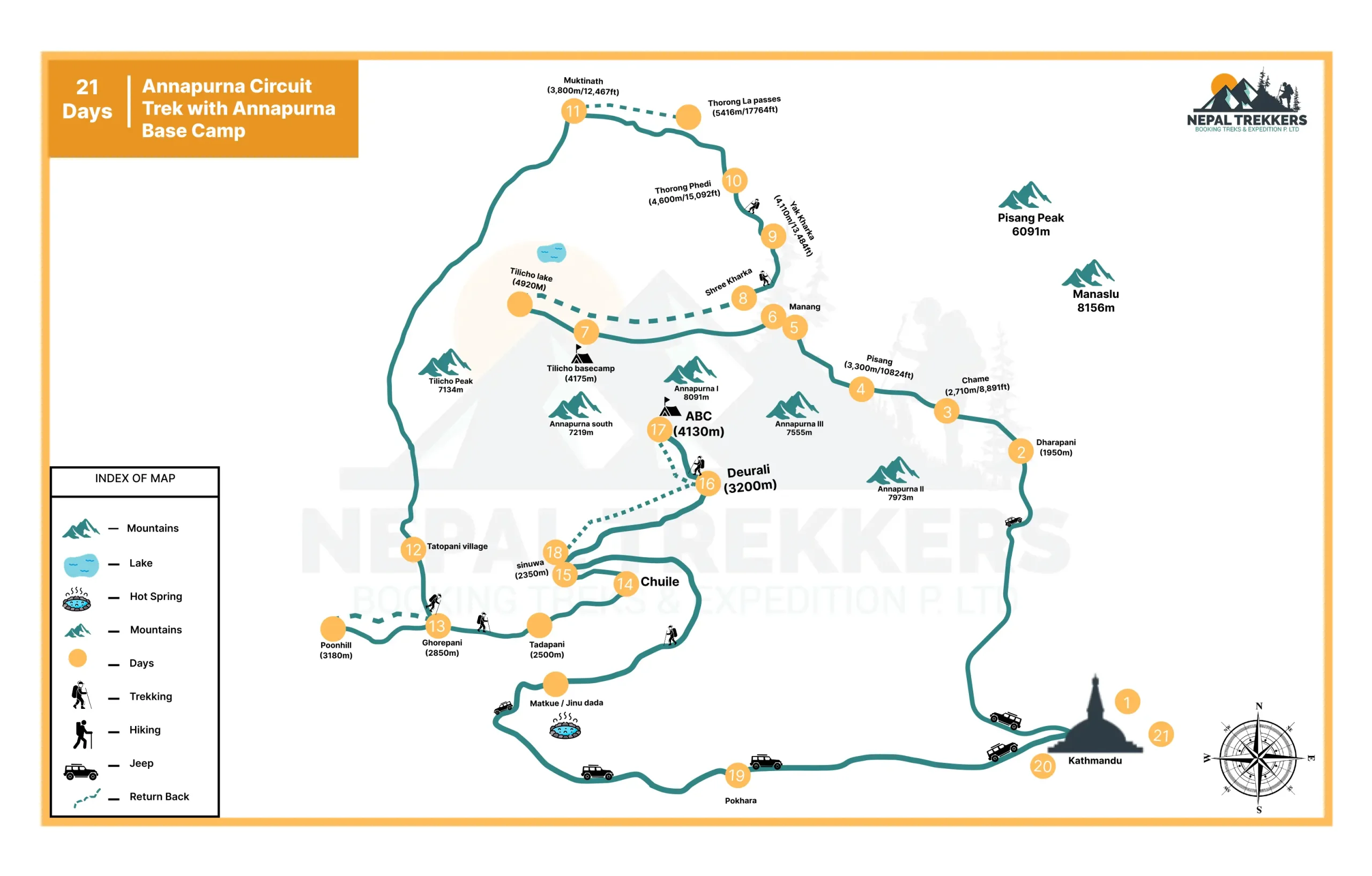
Outline Itinerary
Arrive in Kathmandu and transfer to a hotel
On your arrival, our representative will be at the airport to receive you. The representative will then drive you directly to your hotel. In addition, your guide will meet with you and give you a briefing about your trek after you reach your hotel. Your journey to the Annapurna Circuit with the Annapurna Base Camp hike officially begins one day after your arrival. On the day of your arrival, you will overnight stay in Kathmandu.
Drive from Kathmandu to Dharapani ( 1950m.) by jeep for 10 hours
After an early breakfast, you will board a private Jeep and travel through the mountain viewpoints via Chamaje to Dharapani. We will travel from Kathmandu to Chamaje first, then Chamje, and finally Dharapani. We will pass through another well-known location named Beshishar on the way to Chamje, where we will stop for lunch. You will encounter both smooth and uneven roads along the trip. The picturesque vistas of mountains, hills, and villages will make up for the rough route. After a 10-hour jeep journey, we will arrive in Dharapani where we will have dinner and spend the night at a local resort.
Dharapani to Chame (2,710m/8,891ft): 5 - 6 hours
We cross a few forested hills today on our way to Chame, the administrative hub for the Manang District. We will pass a stone entryway associated with Tibetan Buddhism called a Chorten along the way. As we go to Kyupar from Tyanja, we'll stop to see the falls and the pine forest along the way. Finally, after leaving Kyupar, we go to Chame while taking in the breathtaking vistas of the Himalayas, including Lamjung Himal, Annapurna II, and Annapurna IV (7,525m/24,688ft). On our journey today, we also come across a number of small hot springs where we may cool off and soothe our tired muscles. We'll spend the night in a nearby lodge.
Chame to Pisang (3,300m/10824ft): 5 - 6 hours
We set off on our walk this morning early because we had a lot to cover. Our journey from Chame to Pisang will take us through forested areas and across a suspension bridge. Along a steep, narrow road that passes through a dense forest, we'll eventually arrive at the stunning curved rock face that rises 1500 meters above the river. This section of the Marshyangdi Valley is probably the steepest, and the trail is carved into the vertical rock there. Once you have passed this last stretch of granite, the valley spreads out with stunning views. As the valley widens, to the right is the Paungda Danda, a massive, sloping rock wall that rises more than 5,000 feet (1500 meters) above the trail. Before arriving in Pisang, where we spend the night, we trek for a while.
Pisang to Manang : 6 - 7 hours (upper Pisang way)
We choose the route that passes via Geru and into Upper Pisang out of the two routes that lead to Manang. The magnificent surroundings and the majestic mountains, especially Pisang and Annapurna, are guaranteed to be seen spectacularly from this path. Today, we start to see changes in the landscape and vegetation. The cold and dry weather only makes the environment worse. Our brief visit to Barge Monastery, the largest monastery in the entire Manang area, will stick in our memories. Our nighttime stay is in Manang.
Rest day at the Manang village
When trekking at a high altitude, acclimatization is more crucial than before. As a result, we stayed in Manag village all day on this particular day. While acclimatizing, we'll take a short trip around Manang to learn about its geography and people. We can stroll over to Gangapurna Lake and Bhojo Gumba. Additionally, if your general health is good, we can climb to the Ice Lake at a height of 4500 meters from where you can enjoy the best lake views with views of the Annapurna and Annapurna Himalaya range. But the hike will take about six hours. We eventually spend the night at the Manang hotel.
Manang to Tilicho basecamp (4175m) 6-7 hours
After a leisurely day in Manang, we'll move toward the Tilicho Lake path. To go to Khangsar, a Tibetan settlement well-known for having a long-standing Tibetan Buddhist community, we shall descend. After that, we hike to Shreekharka and continue on a new trail to see other vibrant monasteries. Since it is easier and simpler, the lower route will be taken instead of the upper one. After the strenuous walk, we will soon reach the Tillicho Base Camp.
Tilicho base camp to go to Tilicho lake (4920M) and back to Shree Kharka
On this day, we must get off for Tilicho Base Camp at around four in the morning. We will ascend to the breathtakingly lovely, calm, and cold Tilicho lake. We take a while to relax there while admiring the clear water of Tilicho Lake. After that, we return to the base camp of Tilicho and have breakfast. We then make the walk back to Shreekharka where we spend the night.
Trek to Yak Kharka (4,110m/13,484ft): 4 hours
We will be traveling from Srikharka to Manang today, descending as the trail ascends to Yak Kharka. After leaving Manang Village, the trail ascends to Tenki Village, crosses a creek, and continues climbing out of Marshyangdi Valley before turning northwest and entering Jarsang Khola Valley. The road ascends steadily as it travels north through this valley, passing a few meadows and juniper trees. The trail continues near the tiny settlement of Ghunsa, which is identified by a number of buildings with mud roofs. Now, the road travels through meadows where yaks and horses graze. After passing a small river on a wooden bridge, the trail arrives at Yak Kharka, another little town, where it passes an old Mani wall amid a gorgeous meadow. We spend the night at Yak Karka after arriving there.
Yak Kharka to Thorong Phedi (4,600m/15,092ft): 3 - 4 hours
We will ascend from the Yak Kharka and then descend to the suspension bridge to get to the Ledar hamlet. It will be a challenging two-hour trip. We ascend higher and pass among spectacular rocks before reaching Thorang Phedi, the last town before Thorong La pass. One of the best views of Mt. Gundang, Mt. Syagang, Thorung Peak, and Mt. Khatungkan is our reward for going on this tour. The English translation of the Nepalese word "Phedi" is "mountain foot." The route then climbs to Thorong Phedi, which is at an elevation of 4,525 meters. We eventually make our way uphill to Thorong Phedi, where we spend the night.
Thorong Phedi to Muktinath (3,800m/12,467ft) via Thorong La passes (5416m/17764ft): 7 - 8 hours stay overnight in Muktinath
One of the highest passes in the world, the Thorong La pass, will be our primary objective today. From east to west is the quickest and safest direction to travel through the pass (Manang to Muktinath). We get up at three in the morning and begin the walk since after 10 am, the track is usually under the power of severe winds. The stunning Alps will be visible after your ascent. When we reach the summit, we realize that our effort was worthwhile. We can snap a few shots before moving on to Muktinath Valley at the base of the Thorong La pass. Finally, we arrive at Muktinath Temple, which is surrounded by innumerable monasteries, a naturally heated hot spring powered by natural gas, and an "everlasting flame."
Drive from Muktinath to Tatopani village (6 hours)
This day after breakfast we will drive to Tatopani village from Muktinath. At Tatopani, you can take a swim in the natural hot spring. On the way to Tatopani, we pass Jomsom, Marfa, and Ghasa village and can see Kali Gandaki Gorge, the deepest gorge in the world. Once we arrive at Tatopani village we can spend some time at the natural hot spring pool and stay overnight in that village.
Trek to Ghorepani (2850m) 7-8 hrs
Trek to Ghorepani (2850m) 7-8 hrs We depart from Tatopani for Ghorepani after making use of the hot spring spa there. We ascend to Ghorepani past the Sikha, Chitre, and other Thakali villages after crossing the east bank of the Kali Gandaki River. The walk travels through rhododendron, birch, and magnolia-filled woodlands as well as terraced fields. Ghorepani, which is situated at the summit of a ridge, is renowned for offering breathtaking mountain vistas. You can find a variety of eateries and lodging options in this well-liked tourist area.
Hiking -Poonhill (3180m), trek to Tadapani (2500m) or Chuile . 7 hrs
You'll walk to Poon Hill (3,210m) today before sunrise to see the breathtaking vistas of the Annapurna and Dhaulagiri mountains at first light. From here you will see a superb view of the sunrise and a panoramic view of the Himalayas, including Mt. Dhaulagiri, Annapurna South, Fishtail, and others. After visiting Poonhill, we will come back to Ghorepani, have a hot breakfast, and continue walking to Tadapani. Overnight at guesthouse. Before returning to Ghorepani, you will have breakfast and move towards Tadapani. On reaching Tadapani, you will have to rest and prepare to spend the night there.
Chuile To sinuwa (2350m), 7 hrs
The trail gives good views of the upper Modi valley as it descends from Tadapani. The trail then begins the protracted rise high above the Modi Khola's west bank. At the very foot of Himal Chuli, hidden away, is the settlement of Chhomrong, which we pass by. From Chhomrong, the trail dips to Chhomrong Khola before starting a gradual ascent to our daily target. We spend the night in the inn.
Sinuwa to Deurali (3200m), 6 hrs
We walk for around 2 to 3 hours to get from Sinuwa to Kuldi Ghar. A little further on, there is an opening in the forest from where the path descends quite steeply through a bamboo thicket. We proceed via the meadow of Tomo before arriving at the narrowest part of the canyon, where a shrine and a short trail can be found at Pantheon Barah. The path ascends to the Himalayas and you go two hours farther up the road, into a cave to reach Deurali. On reaching Deurali, we will spend the night in a guesthouse.
Trek to ABC (4130m) stay overnight
Today, we trek to Annapurna Base Camp and on the way make a brief stop at Machhapuchhare Base Camp as the Macchhapucharre (Fishtail) appears mesmerizing from this vantage point. After trekking for some more time, you arrive at ABC where you will have stunning views of Himchuli, the Annapurna Massif, Macchapucchre, Khansari Kang, and Gangapurna. We enjoy the frigid and majesty atmosphere at the foot of the Annapurna mountain, surrounded by peaks higher than 6000 meters. The vistas are out of this world, with snow-capped mountains all around. The prayer flags give the entire journey a spiritual component. Our overnight stay will be at Annapurna Base Camp.
Trek back to Sinuwa and Explore the hidden valley of the ABC
We wake up early to enjoy the sunrise over the Himalayas. The peaks are lit golden by the sunlight. Take your time to snap as many pictures as you want. After breakfast, we retrace our steps back to Sinuwa. Today’s trek is downhill so it shouldn’t be very difficult although you should take care of your shaky legs. Enjoy playing with the crystal clear torrential glacier water. Soon after, we are back in the forest, we continue to Sinuwa for two hours. It’s a long climb down, nearly 2000 meters, but we make it in 9 hours including short breaks for tea and lunch.
Trek to Matkue / Jinu dada ( 4 hours ) then drive back to Pokhara 2 and half hours drive
On the same path that led us to the Annapurna Base Camp, we resume our walk. Jinu Dada is our last destination for the day. The majority of the track is downhill, which can be taxing on your knees. The hot spring we visit at the conclusion of the day is even more interesting than the route, which is just magnificent. A hot spring exists naturally at Jhinu Dada. The hot springs will calm you down and let you forget all of your tension, both physical and mental. It is the ideal approach to wrap up the hike in the Annapurna area. At Jhinu Danda, we'll stay for the night.
Drive back to Kathmandu
Today we make the trip back to Kathmandu. You will be lucky if you get to sit on the left-hand side of the vehicle as you can appreciate the scenery, mountains, gorges, villages, and terraces. After we reach Kathmandu, we will enjoy a farewell supper in a traditional Nepalese restaurant in the evening.
Final departure day
Today marks the end of our journey in Nepal. About 3 hours prior to our trip, one of our representatives will drive you to the airport. You will have plenty of time before your flight. Remember us to organize your upcoming journey in magnificent Nepal.
Includes/Excludes
Cost Includes
- Kathmandu to Besi Sahar by private Hiace with the one guide and two potter:-$ 250 USD
- Besisahar to Dharapani two Jeep fee for 10 people:-$ 400 USD
- 18 days trekking time food (lunch, dinner, and breakfast) and room fee (every meal later you can get fruits and tea or coffee with breakfast, lunch, and dinner):- 7200 USD
- 19 days guide salary fee: - $380USD
- 19 days 6 Potter for 10 people salary fee:- $1710 USD
- Jomsom to Kathmandu potter transportation fee:-$180 USD
- Pokhara to Kathmandu privet Hiace /car fee $220 USD
- Muktinath to tatopani ( hot spring viallage) by bus fee $400 USD
- Two nights in Kathmandu and one night in Pokhara hotel fee with breakfast in three-star hotels: - $675 USD ( in Kathmandu hotel Yatri or hotel Thamel eco-resort and in Pokhara hotel Kuti resort ) Per night double room ) such stander hotel
- TIMS card and trekking permit fee for 10 people: - 450 USD
- Company service charge with government tax fee:-, $400 USD (you can get a kit bag for pack things which carry by potter and first add medicine)
- Airport pick-up and drop fee for the two times $60 USD.
Cost Excludes
- Beverages during the trek
- Meals in Kathmandu
- Kathmandu Sightseeing vehicles and entrance fees
- Tips for trekking staff
FAQS
If you experience any difficulties while trekking higher, such as headaches, nausea, or vomiting, you should quickly descend to a lower altitude. Ibuprofen and Diamox are only allowed to be carried after speaking with your doctor. If the issue gets worse, you need to contact for a medical emergency.
The NTC (Nepal telecom) network functions well up until Khangsar. However, after that you can only connect at Matkue. In spite of being available in every hotel, Wi-Fi connections might occasionally be lost.
The Autumn (September to November) and Spring seasons are ideal for the ACT + ABC trek. The skies are clearer and the snow-covered mountains can be seen clearly during this time of year.
The ACT + ABC trek is quite a challenging kind of trek. The walk consists of a track with a lot of steep ascents and descents, challenging terrain, and surfaces that get icy in the winter and when it’s rainy.
Up until Kathmandu, many ATMs may be found. However, as you’ll be driving through remote parts of Nepal, there won’t be any ATMs along the way. After departing Kathmandu, be sure to have some cash on hand.