
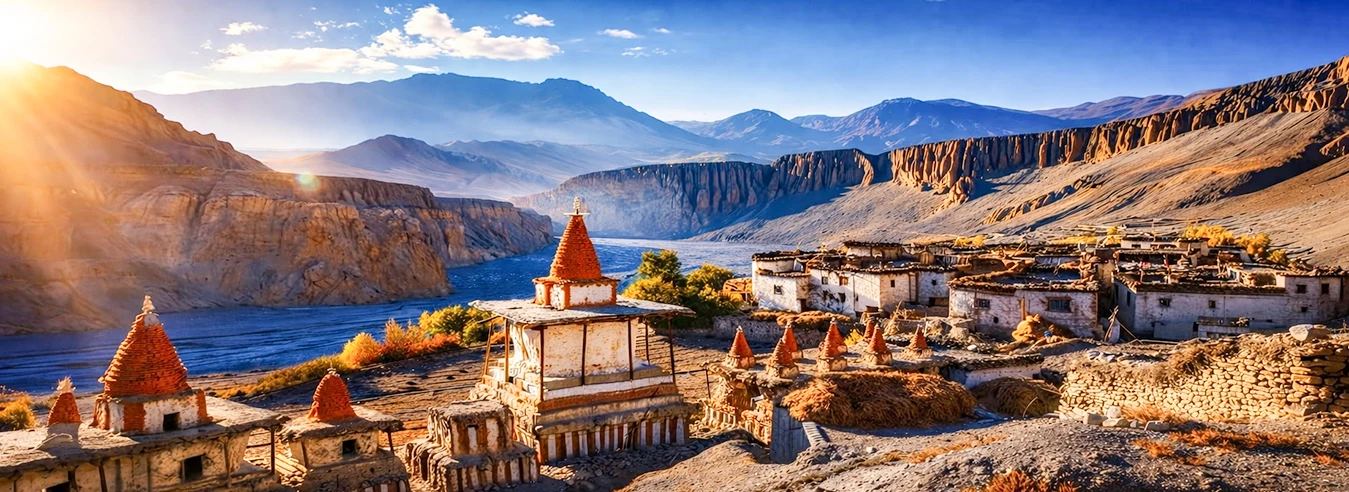
If you have been searching for a Nepal travel experience that goes far beyond normal trekking trails and mountain views then you’ve come to the right blog. Lo Manthang is the place you have been looking for if you want to experience a mystical travel journey above the mountain. Lo is not simply a town but a fully intact medieval walled city which has been continuously inhabited for over 640 years. Most of the world had never heard of it until 1992 because Upper Mustang was sealed to foreign visitors for decades. What those first visitors found when the gates opened was not a ruin or a reconstruction but a living city with a king on a throne, monks chanting in centuries-old monasteries, and farmers tending barley fields irrigated with systems created in the 14th century.
Meaning of Lo Manthang
The name Lo Manthang carries a meaning as beautiful as the place itself. In the local Tibetan dialect spoken by the Loba people, “Lo” means heart or desire, “Man” means wish, and “Thang” means land or plain. After it’s put together you get Lo Manthang which translates to the “Heart’s Desired Land” or “The Land of Aspirations”. The name was chosen by King Ame Pal when he founded the city in 1380. The 14th century name captures something real about how this high desert valley feels to every traveller like you and I reach it after days of trekking through the Kali Gandaki gorge.
Why It Is Called a Walled City
Lo Manthang earns the title walled city because of a physical wall that still stands around most of the settlement today. The wall is 856 metres long, six metres high, and one metre thick, built entirely from compacted clay. Local elders say yaks were used to compact the clay during its original construction. The wall was designed to serve as a fortress protecting the royal palace, the monasteries, and the people of the Kingdom of Lo from raids by rival groups who controlled other valleys in the trans-Himalayan trade region. It is the only continuously inhabited walled city left in the entire Himalayas.
Location and Altitude of Lo Manthang
Lo Manthang sits at approximately 3,800 metres above sea level in Gandaki Province, northern Nepal, close to the border with the Tibet Autonomous Region of China. It lies around 370 kilometres northwest of Kathmandu and about 20 kilometres north of the high-altitude desert settlement of Ghami. The city is positioned in the rain shadow of the Annapurna and Dhaulagiri ranges, which is why the landscape around it looks and feels more like the Tibetan plateau than conventional Nepal. Virtually no monsoon rain reaches this far north, leaving a dramatic desert of red cliffs, eroded canyons, and wide open sky.
Table: Lo Manthang at a Glance
| Key Fact | Detail |
| Altitude | 3,800 metres above sea level |
| Province | Gandaki Province, northern Nepal |
| Distance from Kathmandu | Approx. 370 km northwest |
| Distance from Jomsom | Approx. 50 km north by jeep or trek |
| Wall dimensions | 856 metres long, 6 metres high, 1 metre thick |
| Founded | 1380 AD by King Ame Pal |
| Monasteries | 4 major: Jampa Lhakhang, Thubchen Gompa, Chodey Gompa, Choprang Gompa |
| UNESCO status | Tentative World Heritage List |
| Open to foreigners since | 1992 |
| Population (2011 census) | Approx. 2,350 in Lo Manthang municipality |
History of Lo Manthang and the Mustang Kingdom
The Kingdom of Lo was formally established in 1380 AD by Ame Pal, a warrior chief who unified the scattered communities of the upper Kali Gandaki valley under a single hereditary monarchy. Ame Pal chose the flat plateau north of the Kali Gandaki as the site for his walled capital and named it Lo Manthang. The Royal Palace, a nine-cornered five-storey structure built around 1400. The palace was placed at the heart of the city and served as the seat of every Mustang king across 25 generations of unbroken royal succession. The kingdom grew wealthy by controlling the salt trade route which connected Tibet with the Indian subcontinent through the Kali Gandaki Gorge. Interestingly, it’s the deepest river gorge on earth running between Dhaulagiri at 8,167 metres and Annapurna I at 8,091 metres.
When the Shah dynasty unified Nepal in the 18th century, Lo became a dependency of Nepal but kept its hereditary rulers and semi-autonomous status. The arrangement lasted until 2008 when Nepal abolished its own monarchy and stripped the Mustang king of his official title. The last king, Jigme Dorje Palbar Bista, who was born in Lo Manthang Palace in 1930 and traced his direct lineage back to Ame Pal across 25 generations, passed away in 2016. His palace in the centre of Lo Manthang now stands empty and serves as a powerful yet quiet reminder of a dynasty that lasted over six centuries.
Tibetan Cultural Influence in Lo Manthang
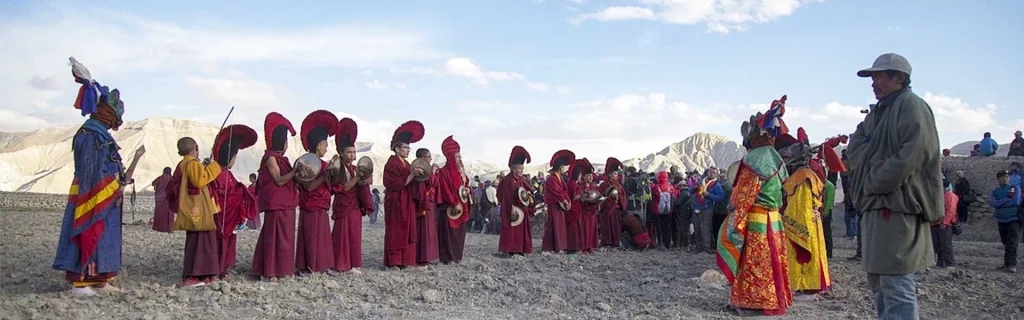
Because Upper Mustang sits north of the Himalayan rain barrier and was geographically isolated from lowland Nepal for centuries, its culture developed almost entirely in alignment with Tibetan traditions rather than Nepali ones. The Loba people, the indigenous inhabitants of Lo Manthang, speak traditional Tibetan dialects, practice the Sakya school of Tibetan Buddhism, and maintain customs that have changed little since the 15th century. The monasteries of Lo Manthang, particularly Thubchen Gompa built in the late 15th century and Jampa Lhakhang built in the early 15th century, contain Buddhist murals and thangka paintings that are among the oldest surviving examples of Himalayan Buddhist art anywhere in the world. In 2007, a shepherd near the city discovered 12 cliff caves decorated with Buddhist paintings dating to the 13th century, painted in silver, gold, and mineral pigments from the surrounding cliffs.
Role of the Mustang King in the Kingdom of Lo
The Mustang king was not simply a political figure. He served as a guardian of the Tibetan Buddhist faith, a patron of the monasteries, and the central authority who maintained the religious and cultural life of the entire region. His decisions about trade, land use, and relations with Tibet shaped the valley for centuries. The Tiji Festival, Lo Manthang‘s most important annual celebration, was traditionally held under royal patronage. Monks from all surrounding monasteries gathered inside the walled city to perform three days of masked ritual dances representing the triumph of good over evil. Even after the formal abolition of the monarchy in 2008, the cultural authority of the royal family remained deeply felt among older Loba communities.
Why Lo Manthang Is One of Nepal’s Most Unique Places
You can trek to dozens of dramatic destinations in Nepal and Lo Manthang is different from all of them in a way genuinely difficult to explain in words. It feels like a place going about its own business for 640 years and has simply decided to allow you inside for a while. Listed here are few things which make it unlike anywhere else in the Himalayas of Nepal:
- It is the only continuously inhabited medieval walled city left in the entire Himalayan region.
- The Chosar sky caves north of Lo Manthang contain Buddhist paintings from the 13th century that predate anything in Kathmandu’s oldest temples.
- The surrounding landscape is a high-altitude desert of red and ochre eroded cliffs that looks and feels like the Tibetan plateau, not like Nepal.
- The Tiji Festival, held once a year inside the walled city, is one of the most visually spectacular religious festivals in the entire Himalayan world.
- The region produces its own apple-based Mustang wine which is a local agricultural product unique to the cold dry climate of the valley.
- Tibetan butter tea is served in every teahouse, and the food culture, architecture, and daily rhythms of life are closer to pre-modern Tibet than to contemporary Nepal.
How to Reach Lo Manthang
Getting to Lo Manthang takes planning, time, and the right documents. You have two main options for reaching Jomsom, which is the gateway hub for Upper Mustang. From Jomsom the road continues north through Kagbeni and into the restricted area toward Lo Manthang.
Table: Lo Manthang Trail route Details
| Route | Method | Duration | Notes |
| Kathmandu to Pokhara | Flight or tourist bus | 25 min flight / 6 to 7 hrs bus | Most trekkers fly to Pokhara |
| Pokhara to Jomsom | Domestic flight | 25 minutes | Flights depart early morning, book in advance |
| Jomsom to Kagbeni | Jeep or trek | 1 hr jeep / 3 hrs on foot | Kagbeni is the Upper Mustang gateway |
| Kagbeni to Lo Manthang | Jeep (4WD road) | 5 to 7 hrs one way | Rough unpaved road, 4WD vehicle required |
| Full Upper Mustang trek on foot | Trekking | 8 to 12 days return from Jomsom | The most rewarding way to experience the region |
Tip for you: Book your Pokhara to Jomsom domestic flight at least 2 weeks in advance during spring and autumn peak seasons. Seats fill quickly and the flight is cancelled on many mornings due to high winds in the Kali Gandaki valley.
Permits Required to Visit Upper Mustang
Upper Mustang is a restricted trekking area. You cannot enter without the correct permits in hand and a licensed Nepali trekking guide accompanying you at all times. These are not optional requirements. They are enforced at checkpoints along the route with permit inspections. Getting all permits sorted in Kathmandu or Pokhara before your departure is very essential.
Table: Permits required for travellers to upper mustang.
| Permit Type | Cost (Per Person) | Valid For | Where to Get |
| Upper Mustang Restricted Area Permit | USD 500 | 10 days | Nepal Tourism Board, Kathmandu or Pokhara |
| Annapurna Conservation Area Permit (ACAP) | NPR 3,000 (approx. USD 23) | Full trip duration | Nepal Tourism Board office |
| TIMS Card | NPR 2,000 individual / NPR 1,000 agency group | Full trip duration | TAAN office or registered agency |
Best Time to Visit Upper Mustang and Lo Manthang
One of the things which makes Upper Mustang genuinely special is the fact that it sits in the rain shadow of the Annapurna and Dhaulagiri ranges. It means the monsoon barely reaches the region from June to August. Making it one of the very few places in Nepal you can trek reliably during incessant monsoon rain months when most other trails are flooded and cloudy.
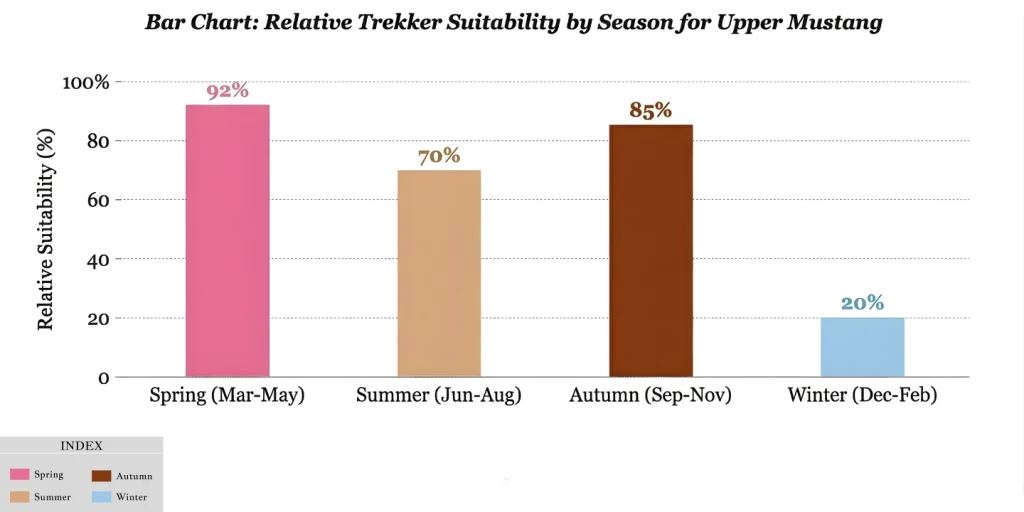
Spring and Autumn are peak seasons for Lo Manthang, Summer is uniquely viable due to the rain-shadow effect. Winter sees very limited activity.
- Spring (March to May): Warm days, clear skies, Tiji Festival usually falls in May, rhododendrons at lower elevations
- Summer (June to August): Rain shadow keeps the valley dry while the rest of Nepal is monsoon-soaked. A genuinely good time with far fewer crowds
- Autumn (September to November): Crystal clear air, excellent mountain views, most popular season overall
- Winter (December to February): Temperatures drop below minus 20 degrees Celsius at night. Many teahouses close and the road north of Kagbeni can become impassable
Culture, Religion, and Local Life in Lo Manthang
Walking inside the walls of Lo Manthang gives you a direct window into a way of life the rest of the world has largely left behind. The Loba people, who are approximately 2,350 in Lo Manthang municipality, maintain daily routines shaped by Tibetan Buddhist practice, high-altitude farming, and centuries of cultural continuity.
Butter tea, brewed from tea leaves, yak butter, and salt, is the drink of daily life. You will be offered it in every home and teahouse as a gesture of welcome. The monasteries inside Lo Manthang hold active daily rituals that you are welcome to observe respectfully from the doorways. Monks chant in the early morning in Thubchen Gompa, the great red assembly hall built in the late 15th century. The interior walls in Gompa are covered in 500-year-old Buddhist murals that an international team of conservators has been restoring since the early 2000s.
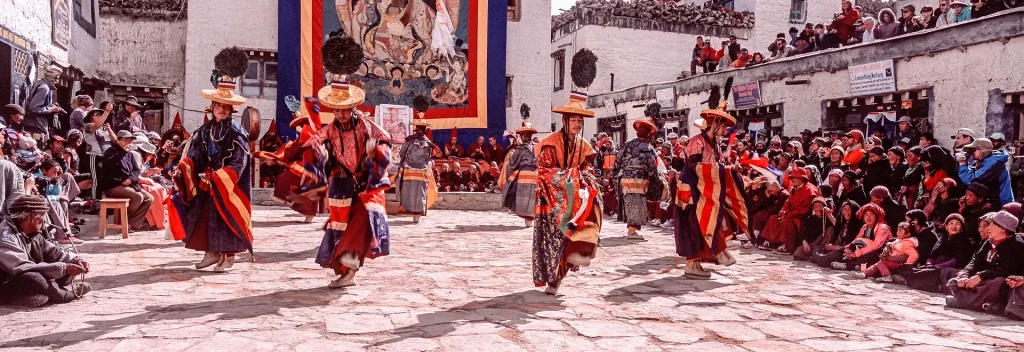
The Tiji Festival, held once a year in late April or May within the walled city, is the cultural and religious high point of the entire Upper Mustang calendar. For three consecutive days, monks from all surrounding monasteries perform elaborate masked dances inside Lo Manthang. The festival tells the story of a deity who saves the Kingdom of Lo from destruction. The entire community dresses in traditional attire, the monasteries fill with incense and prayer, and the city transforms into a living ceremonial space. If your trip timing allows it, planning your visit around the Tiji Festival is one of the best decisions you can make.
Lo Manthang Is Waiting for You
Every place in Nepal has something to offer. Lo Manthang offers something rare. It offers a complete civilisation, intact, inhabited, and still going about the quiet routines of a culture that dates back to the 14th century. The walls are real. The monasteries are ancient. The king’s palace still stands at the heart of the city. The Loba people who live inside those walls are not performers or exhibits. They are the continuation of a human story that has been running in this high desert valley for over 640 years.
If you are planning your Nepal trek and want a destination that gives you not just mountains but meaning, not just altitude but history, the Upper Mustang trek to Lo Manthang is the one that will stay with you the longest.
Frequently Asked Questions On Lo Manthang
1. Do you need a special permit to visit Lo Manthang?
Yes, visiting Lo Manthang requires an Upper Mustang Restricted Area Permit that costs USD 500 per person for 10 days. This is in addition to the standard Annapurna Conservation Area Permit (ACAP) and the TIMS card. You must also trek with a licensed guide at all times.
2. When is the best time to visit Lo Manthang for the Tiji Festival?
The Tiji Festival is held once a year, usually in late April or May, with the exact dates following the Tibetan lunar calendar. The 2025 Tiji Festival took place in May.
3. How long does it take to reach Lo Manthang from Jomsom?
By 4WD jeep on the unpaved road, Lo Manthang is about five to seven hours from Jomsom depending on road conditions. If you choose to trek the full distance from Jomsom, the journey takes eight to twelve days.
Feels like sharing this blog to your circles?


Comments 0