
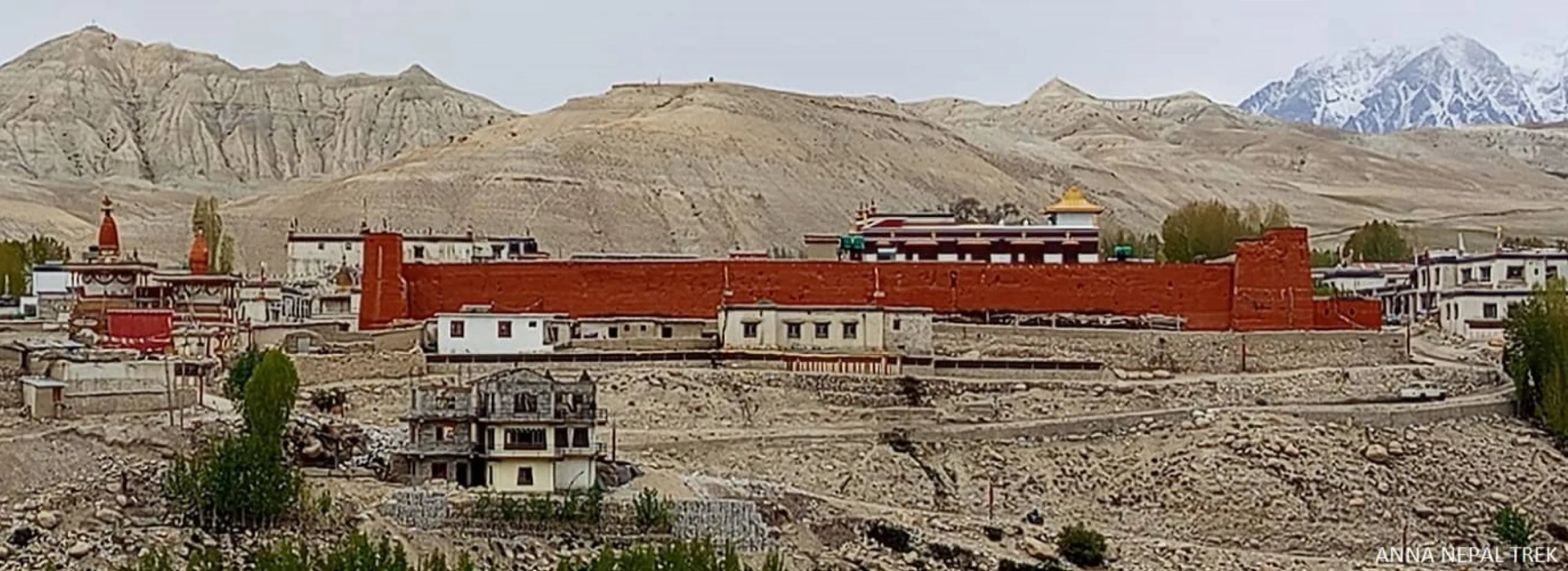
The Upper Mustang trek is a high-altitude trek in northern Nepal that lets every traveller explore an ancient kingdom, culture, unique geography, and a deep valley carved by the Kaligandaki River. It is an exploration of the rain-shadow desert in Nepal’s Himalayan region. Upper Mustang is also known as the “Forbidden Kingdom,” located in the Annapurna and Dhaulagiri ranges, which borders Tibet in the north. The high-altitude region, special logistic requirements, limited accommodation, and restricted area make it one of the most expensive treks in Nepal. Besides cost, a trek here gives you an opportunity to explore windy high-altitude terrain, the medieval wall in Lo Manthang, ancient monasteries, and the lifestyles of local people in the region.
This guide explains why the Upper Mustang trek is expensive in comparison to other treks in Nepal. We give an explanation with reasons for the high cost to trek in the Forbidden Kingdom by providing detail about its route, permit requirement, permit costs, and trek difficulty.
Upper Mustang Trek

The Upper Mustang trek is one of the most unique and special destinations in Nepal. It is special because of its dry and desert-like terrain, rain shadow region, and culture. The trek expedition here provides you with a chance to discover rich Tibetan culture, centuries-old traditions, medieval caves, and monasteries. On the journey, trekkers pass nearby the Kaligandaki River, dry deserted terrain, and winding paths to Lo Mangthang (3,840 m) and Chogo La Pass (4,320 m).
The Upper Mustang, also known as the Last Forbidden Kingdom, is the prohibited region of Nepal, the entry of which is expensive and needs a permit. The low accommodation facilities, logistical challenges, expensive transportation, and the requirement of a guide make it more expensive than other Nepal treks in addition to the permits. Beside the cost, it is a place to visit once in a lifetime because of its experience, exploration possibility, and beauty of the area.
Upper Mustang Trek: Routes and Starting Point
The Upper Mustang trek is considered a moderately difficult trekking route that starts from Jomsom in the lower Mustang. The trek usually takes an average of 15-18 days depending upon the trek package, trek organizer, and trekker’s pace. You reach Lo-Manthang, the major place of attraction in the trek. You can also choose an optional route to reach Chogo La Pass during your return to Drakmar from Lo-Manthang. The ending point for the trek will be the same point where you started the journey. Below we provide a table that shows the detail of your trek route, starting point, and altitude.
| Route | Trekking Time (in hrs) | Altitude |
| Kathmandu to Pokhara | Flight | Pokhara 822 m |
| Pokhara to Jomsom and then Kagbeni | Flight, and 3-4 hours trek | Jomsom 2,720 mKagbeni 2,800 m |
| Kagbeni to Chele (or Tsele) | 5 to 6 hrs | Chele 3,050 m |
| Chele to Syangboche | 5 to 6 hrs | Taklam La (3,624 m)Yamda La (3,850 m) |
| Syangboche to Ghami | 5 to 6 hrs | Ghami 3,520 m |
| Ghami to Charang | 4 to 5 hrs | Charang 3,560 m |
| Charang to Lo-Manthang | 4 to 5 hrs | Lo-Manthang 3,840 m |
| Explore Lo-Manthang | Exploration | 3,840 m |
| Lo-Manthang to Drakmar | 6 to 7 hrs | Chogo La Pass 4,320 m (Optional) |
| Drakmar to Ghiling | 5 to 6 hrs | Ghiling 3,806 m |
| Ghiling to Chhusang | 6 to 7 hrs | Chhusang 2,980 m |
| Chhusang to Muktinath | 6 to 7 hrs | Muktinath 3,750 m |
| Muktinath to Jomsom | 6 to 7 hrs | Jomsom 2,720 m |
| Jomsom to Pokhara | Flight | Pokhara 822 m |
| Pokhara to Kathmandu | Flight | 1,324 m |
Why is the Upper Mustang Trek Expensive?
As we mentioned earlier, the Upper Mustang Trek is expensive due to several reasons, including remote location, high permit cost, high transportation cost, and limited accommodation facilities. The trek is isolated and is located in a remote area bordering Tibet in the north.
i. Remote location and low accommodation
Upper Mustang is located in the remote location of Nepal beyond the Himalaya. You trek to a low-populated region where accommodation facilities are low. The lack of cultivation, dependencies upon imports from the city, and limited resources make the region expensive.
ii. High logistic and transportation costs
The transportation to reach the trek head is mainly by flight and scenic bus or private jeep ride. Trekkers require paying high transportation fees to reach the trek starting point. Also, managing logistics is also difficult due to higher transportation costs, difficult terrain, and the remoteness of the region.
iii. Restricted area and high permit cost
As Upper Mustang is located in the restricted area of Nepal, trekkers are required to pay a Restricted Area Permit (RAP) for entry. The permit cost is high in comparison to other permits in Nepal. In addition to RAP, trekkers also require an Annapurna Conservation Area Permit (ACAP) and Trekkers Information Management System (TIMS) to trek in Upper Mustang.
iv. Mandatory Licensed Guides and Minimum Group Size
In addition to permit, transportation, and accommodation costs, the mandatory guide and minimum group size requirement make the trek expensive. As it is mandatory to bring a licensed trekking guide and you require a trek in a group, the cost and fee of the guide, in addition to the per-head cost of the group, make the trek more expensive.
Permit for Upper Mustang Trek
| Permit Type | Fee or Costs |
| Restricted Area Permit (Upper Mustang) | USD 500 for first 10 days and additional USD 50 per day after |
| Annapurna Conservation Area Permit (ACAP) | NPR 3,000 (USD 23-25)NPR 1,000 for SAARC NationalsNPR 100 for Nepalese citizens |
| TIMS Card (if required) | NPR 2,000 for foreignersNPR 1,000 for SAARC Nationals |
Permit cost for Nepali
Nepalese citizens planning for the Upper Mustang trek must obtain the Annapurna Conservation Area Permit (ACAP), which costs around NPR 100 per entry. In terms of the TIMS card, Nepalese citizens are not required to obtain a TIMS card when trekking to the Upper Mustang.
Permit Cost for Foreigners
The permit cost to enter Upper Mustang for foreigners is costly in comparison to other treks like Annapurna Base Camp and Mardi Himal Trek in the region. As it is located in a restricted area, foreign trekkers are required to obtain a Restricted Area Permit (RAP) to trek in the region. The RAP costs USD 500 for the first 10 days, and if a trekker spends more than the permitted limit, they are required to pay USD 50 per day. In terms of ACAP permits, foreigners and SAARC nationals are required to pay NPR 3000 and NPR 1000, respectively. Similarly, the cost of the Trekkers Information Management System (TIMS) for foreigners and SAARC nationals is NPR 2000 and NPR 1000.
Upper Mustang Trek Difficulty

The trek to the Forbidden Kingdom of Nepal is a moderately difficult adventure where trekkers are required to walk for an average of 5 to 7 hours a day. The trek here doesn’t require technical climbing skills like another alpine trek in Nepal.
However, the dry climate, strong wind, and remote area make the adventure moderately difficult. If you are a beginner or have previous trekking experience, you can successfully perform the trek while having moderate physical fitness.
It is also important to remember that the Upper Mustang region is located above an altitude of 3000 m, reaching 4200 m, and some trekkers may face altitude sickness during the trek. Hence, proper trek preparation, altitude medication, and moderate physical fitness can make the trek safe and comfortable.
Conclusion
The Upper Mustang region trek is an exploration of Nepal’s Forbidden Kingdom, rich culture, ancient monasteries, and medieval palaces and caves. Being located in the northern rain shadow region of Nepal, most of the area is dry and sparsely populated. Being a restricted area, the cost of a permit to trek in the region is also higher than another major trek in Nepal.
Additionally, the high transportation costs, logistic charges, and mandatory guide and group requirement make the trek expensive. But regardless of cost, trekking in this isolated region is a lifetime opportunity to explore unique landscape, Tibetan-influenced culture, and high-altitude Himalayan lifestyle. Contact Trekkers Nepal for further information about the Upper Mustang Trek or any other major trekking destination in Nepal.
Feels like sharing this blog to your circles?


Comments 0